Wednesday, 13 August 2014

NUCLEIC ACIDS:: PART 5

DNA (Deoxyribose Nucleic Acid)

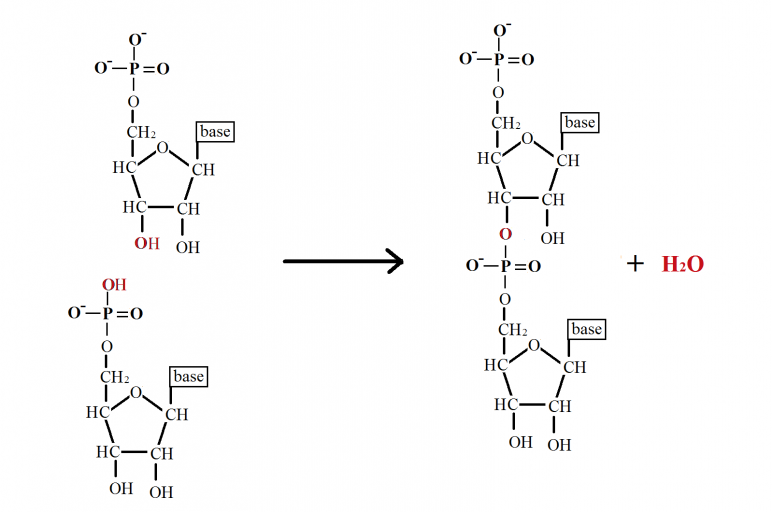
-          It is polymer of nucleotide monomers joined by phosphodiester bonds.

-          Purines and Pyrimidines carry genetic information whereas pentose sugar and phosphate group perform structural role.

-          In a DNA phosphodiester bond is formed between 5’phosphate group of one nucleotide and 3’hydroxyl group of another nucleotide.
                                         
-          This contains four nitrogenous bases adenine, guanine, thymine and cytosine.
                                                

-          RNA is similar but it has Uracil in the place of thymine.

Tuesday, 12 August 2014

NUCLEIC ACIDS:: PART 4

Nucleotides

-          These have several functions in the cell.

-          Form DNA and RNA.

-          Carriers of chemical energy: -

o   Nucleotides with one, two or three phosphate groups are called monophosphate, diphosphate or triphosphate.
o   NTPs (nucleotide triphosphate) are sources of energy in any biochemical reaction.
                                  
o   ATP is widely used but other NTPs are used in specific reactions.
o   Hydrolysis of NTPs releases energy.

-          Enzyme cofactors: -

o   Many enzyme cofactors and coenzymes contain adenosine as part of their structure.
o   Removal of adenosine from the cofactors decreases their activity.
                                
o   Example: - acetyl Co-A.

-          Chemical messenger: -

o   Hormones and chemical signalling agents are called messengers.

o   These messengers induce secondary messengers inside the cells which are generally nucleotides.

Monday, 11 August 2014

NUCLEIC ACIDS:: PART 3

Pentose sugar

-          It is present in both nucleic acids in two different forms.

-          The two nucleic acids are distinguished primarily on the basis of 5-carbon keto sugar or called ribose.
                                                     
-          DNA has 2-deoxyribose nucleic acid and RNA has ribose nucleic acid.
                               

-          Ribose reacts with orcinol in HCl solution containing FeCl whereas deoxyribose diphenylamine in acidic solution.

-          Compounds containing only nitrogenous bases and pentose sugars are called nucleosides.


-          Nucleotides contain pentose sugar, nitrogenous base and phosphate group.
                            

Saturday, 9 August 2014

NUCLEIC ACIDS:: PART 2

NITROGENOUS BASES

-          These are most important constituent of both DNA and RNA.

-          These are classified into two groups based upon their structure.

-          PYRIMIDINES

o   It is heterocyclic (a cyclic compound with more than one type of atoms) compound.

o   Pyrimidines constitute of three nitrogenous bases

o   Thymine: -
§  Found only in DNA.
§  Chemical composition C5H6O2N2.
o   Cytosine: -
§  Found both in DNA and RNA.
§  Chemical composition is C4H5ON3.
                    
o   Uracil: -
§  Found only in RNA.
§  Chemical composition is C4H4O2N2.

-          PURINES

o   It is a pyrimidine ring that is attached to another 5-membered ring.

o   Purines constitute of two nitrogenous bases.

o   Adenine: -

§  Found both in DNA and RNA.
§  Chemical composition is C5H5N5.
          
o   Guanine: -
§  Found both in DNA and RNA.

§  Chemical composition is C5H5ON5.

Wednesday, 6 August 2014

NUCLEIC ACIDS:: PART 1

INTRODUCTION
-          Nucleic acids are energy molecules that derive metabolic processes in all cells.

-          These nucleic acids form our DNA, which is referred as our heredity material.

NUCLEOTIDE

-          It is the actual molecule that makes up our DNA (deoxyribo nucleic acid) and RNA (ribonucleic acid) as well.

-          DNA is our genetic material whereas RNA makes up our genetic code.
                                         
-          DNA is more likely to be found in nucleus and less in cytoplasm.

-          RNA is more likely to be found in cytoplasm and less in nucleus.
-          Upon hydrolysis of DNA three components are obtained: -  

o   Phosphoric acid
        
o   Pentose sugar
                    

o   Nitrogenous base